
-
Segments
-
Retail Banking
Personalized omnichannel customer journeys
-
Commercial Banking
Complex relationships and lending workflows
-
Credit Unions
Automation and member-centricity at scale
FeaturedExplore The State of Enterprise AI Adoption Report: Financial ServicesEdition Exclusive insights from 190+ banking and credit union leaders -
Retail Banking
-
Grow
Customer IntelligenceAcquisitionExpansion & Retention
-
Serve
Contact CenterAccount & Product ServicingCustomer Experience
-
Operate
KYC & Fraud PreventionRegulatory & Risk
-
Insights
-
Case Studies
How banks run AI agents in production
-
Thought Leadership
Research on the future of banking
-
Events
Webinars, roundtables, and conferences
FeaturedExplore The State of Enterprise AI Adoption Report: Financial ServicesEdition Exclusive insights from 190+ banking and credit union leaders -
Case Studies
- About Creatio

Build & Scale Financial Services Ops with Creatio’s AI CRM

Creatio CRM for financial services is an AI CRM and workflow platform built for banks, credit unions, lenders, wealth managers, and insurers, where people and AI agents work together on one governed foundation. It is delivered to banks and credit unions as Creatio Bank.AI, and it runs beside the core banking system to create a complete system of customer relationship management and business process automation. This article explains what Creatio offers each financial services segment, which AI agents it includes, how it integrates with core and fintech systems, what it costs, and how it compares to other financial services CRMs.
Key Takeaways
- Creatio CRM for financial services is an AI CRM and workflow platform for banks, credit unions, lenders, wealth managers, and insurers; Creatio Bank.AI is its banking edition.
- Financial services is Creatio’s largest industry, with thousands of financial services customers such as Wings Credit Union, CEC Bank, OTP Bank Romania, Metro Bank, First United Bank & Trust, and Consumers Credit Union.
- Banking work is organized into three domains, Grow, Serve, and Operate, with pre-built workflows for customer 360, onboarding, lending, servicing, contact center, KYC, AML, and regulatory reporting.
- Pre-built AI agents include Relationship Manager, Customer Onboarding, Referral, Next Best Offer, Renewal, Account Servicing, Product Application Intake, Dispute Resolution, and Document Processing agents, each governed in Creatio AI Studio with a human in the loop.
- Creatio connects to core banking, loan origination, payments, identity, document, and e-signature systems through APIs, events, Marketplace connectors (including Fiserv Premier and Jack Henry Symitar), and MCP, and never trains AI models on customer data.
- Measured results include 18.5% more new deposit conversions and $1.4 million in annual revenue uplift at Wings Credit Union, and 37% lower technology cost and 70% faster implementation (according to Nucleus Research).
- Creatio is licensed as Unlimited Enterprise (one subscription, no limits on users, agents, workflows, or scale) or per seat in Growth and Enterprise plans; AI packages start at $5,000 per year.
What Is Creatio CRM for Financial Services?
Creatio CRM for financial services is an AI CRM and workflow platform that gives financial institutions unified records of every customer relationship, pre-built financial services workflows, and AI agents that work inside those workflows, with no limits on users, agents, workflows, or scale. Creatio sells it as Creatio Bank.AI for banks and credit unions, and as industry workflows for lending, mortgage, wealth management, and insurance on the same platform.
Creatio Bank.AI is the banking edition of the horizontal AI CRM platform. It covers the full relationship lifecycle across three domains: Grow (customer 360, prospecting, onboarding, referrals, next best offer, retention, and renewals), Serve (contact center, case and complaint management, account and product servicing, disputes, and SLAs), and Operate (KYC, AML, document processing, risk, and regulatory reporting). Each domain ships with workflows and pre-built AI agents that prepare, check, and complete approved steps while employees approve what risk requires.
Creatio’s default licensing is the Unlimited Enterprise subscription model: one platform subscription covers unlimited users, applications, workflows, custom objects, and API calls, so a bank can extend the platform from the contact center to lending, collections, and compliance without adding seats or modules.
Creatio CRM vs. Generic CRM vs. Core Banking System
A core banking system is the system of record for accounts and transactions. A generic CRM is a system of engagement that must be adapted to financial services. Creatio is a system of engagement and orchestration for customers, employees, and AI agents that runs on top of the core and is built for financial services from the start. The table below shows how the three differ.
Dimension | Creatio CRM for Financial Services (Bank.AI) | Generic CRM | Core Banking System |
|---|---|---|---|
| Purpose | Grow relationships, serve customers, and run compliant operations | Track contacts, deals, and tickets for any industry | Open accounts, post transactions, and keep the ledger |
| Data model | Customers and households, financial accounts, cards, loans, policies, applications, products, and financial indicators out of the box | Generic contacts, accounts, opportunities, and cases; financial objects must be added by the customer | Accounts, transactions, products, and general ledger; little relationship data |
| Prebuilt financial services workflows | Onboarding and KYC, applications, product fulfillment, servicing, complaints, collections, compliance, and regulatory reporting | None; configured or built by partners | Transaction processing only |
| AI agents | Pre-built banking agents inside the workflow, governed in Creatio AI Studio, plus unlimited custom agents | General sales and service assistants; industry agents are add-ons or custom builds | Little or none; AI typically sits in separate tools |
| Customization approach | No-code designers for data, workflows, interfaces, and agents, used by business and IT teams | Administrators, developers, and partners; industry fit needs heavy configuration or code | Vendor-controlled release cycle |
| Relationship to the core | Reads live core data through APIs and events and acts across systems; never replaces the core | Point integrations, often with copied data | Is the core |
In practice, a financial institution keeps its core as the system of record and adds Creatio as the layer where relationship managers, contact center staff, operations teams, and AI agents connect with customers and do their work.
Key Capabilities of Creatio CRM for Financial Services
Creatio organizes its financial services capabilities into pre-built workflow modules that institutions deploy as they are and then adapt with no-code tools. The modules cover the customer lifecycle, product fulfillment, operations, and risk and compliance, and all of them share one data model and one customer record.
Customer 360 and Customer Management
Customer 360 in Creatio is a single profile of each customer or member that combines data from the core banking system, loan origination system, contact center, and marketing into one record. Staff see accounts, products, interactions, cases, and household relationships on one screen, and AI agents use the same record as their context.
- Customer, household, and organization profiles with financial indicators and product holdings
- Interaction history across branch, contact center, email, chat, and messaging channels
- Segmentation, portfolio management, and next best offer recommendations in the employee workspace
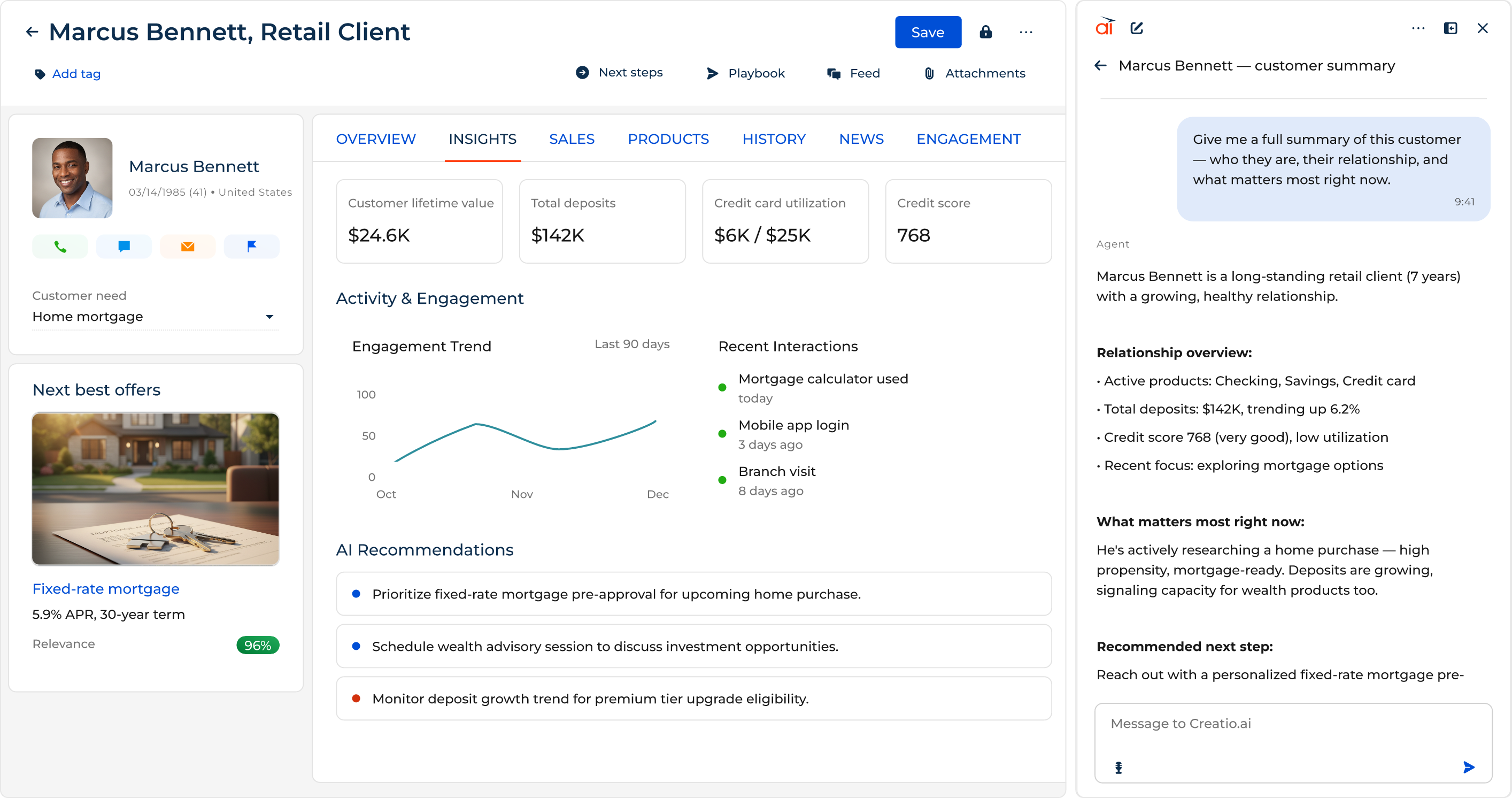
Customer 360 view in Creatio Bank.AI
Financial Products
Creatio includes a financial product catalog and dedicated objects for cards, bank accounts, loans, and insurances. Product data flows into applications, servicing, and marketing without re-keying.
- Product catalog with terms, conditions, and eligibility rules
- Deposit accounts, retail loans and lines, credit cards, mortgage, wealth, and insurance product records
- Product holdings linked to each customer and household, with cross-sell recommendations
Application Management
Application management in Creatio runs the intake, verification, decision, and fulfillment of applications for deposits, loans, cards, mortgages, and insurance. Applications move through configurable stages with checklists, document requirements, and approval rules, and AI agents can prepare the file before a person decides.
- Omnichannel application intake from branch, web, mobile, and contact center
- Document collection, verification checklists, and version-controlled document management
- Eligibility checks, role-based approvals, and automated status communication
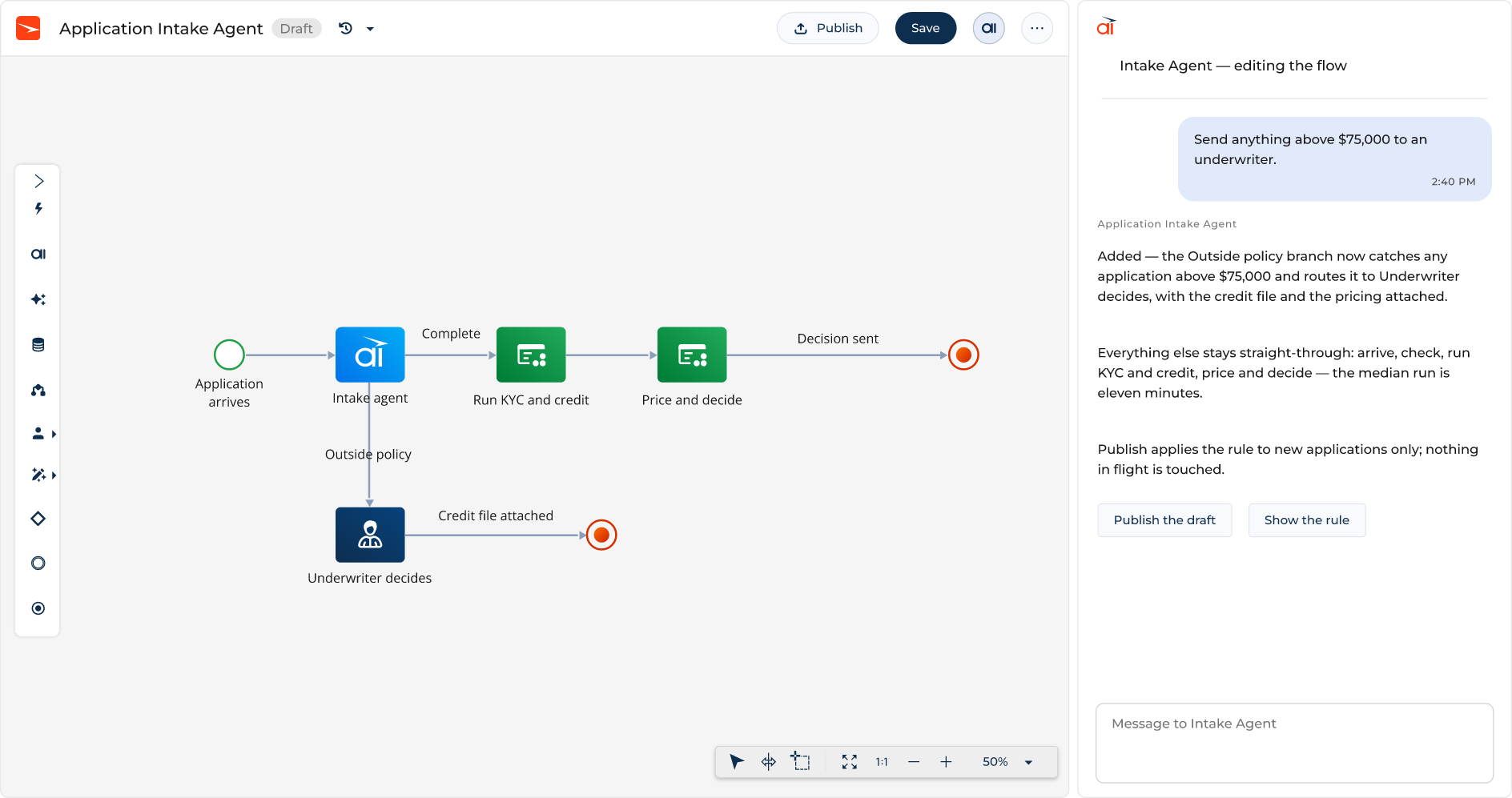
Product Application Intake Agent running KYC and credit checks
Customer Service and Case Management
Creatio gives financial institutions a contact center desktop, case and complaint management, and self-service channels on the same customer record used by sales and operations.
- Contact center desktop with unified customer context and scripted consultations
- Case, complaint, and dispute management with SLAs and escalation rules
- Account and card servicing requests, with NPS tracking tied to each interaction
KYC, Compliance and Risk Management
Creatio provides out-of-the-box compliance workflows that run KYC and AML checks, assess cases against approved policies, and generate reports, and it stores every evaluation in the customer workspace for audit. Agents verify documents and run checks; only exceptions and regulated decisions reach a person.
- KYC profiles, document verification, and periodic review workflows
- AML and BSA screening with case creation for alerts
- Risk catalog, collateral, and escrow management, regulatory reporting, and internal audit automation
Creatio CRM by Financial Services Segment
Creatio serves more than 7,000 financial institutions from about $500 million to more than $250 billion in assets with pre-built workflows and the agents that matter to mid-size and large financial institutions.
Retail Banking
Creatio for retail banking gives banks one customer record across branch, contact center, and digital channels, with workflows for onboarding, deposit and card applications, servicing, complaints, and campaigns. CEC Bank, the third-largest bank in Romania, runs more than 4,000 client-facing employees across 1,000 or more branches on Creatio, with Creatio as the master data layer streaming events to a modernized core. For example, OTP Bank Romania automates onboarding, data management, and lending for 1,800 or more users.
Best for: retail and universal banks from about $1 billion to $50 billion or more in assets that want a system of engagement beside an existing or modernizing core.
Commercial and Business Banking
Creatio for commercial banking supports relationship-managed portfolios with opportunity management, commercial sales workflows, treasury and lending referrals, and a Relationship Manager Agent that prepares account summaries, meeting briefs, and next steps. For example, Metro Bank in the United Kingdom runs Creatio workflows and orchestration through APIs across more than 50 systems, with 1,500 or more users managed by a team of three.
Best for: commercial and business banking divisions of midsize and large banks that need portfolio visibility and consistent coverage across relationship teams.
Credit Unions
Creatio for credit unions is the Bank.AI platform applied to member relationships: Member 360, leads and referrals, member onboarding, loan application intake, case management across branches and the contact center, and compliance. For example, Wings Credit Union deployed Creatio to 1,200 users in 3.5 months and gained 18.5% more new deposit conversions and 8.5% more new loan conversions. And Consumers Credit Union consolidated 15 systems into one platform integrated with its core, loan origination system, and phone system.
Best for: credit unions from about $500 million to more than $10 billion in assets that want member-facing teams, not developers, to own workflow changes.
Lending and Mortgage
Creatio for lending and mortgage covers lead and referral management, partner and broker portals, loan application management, underwriting checklists and analytics, document management with version control, servicing reminders, and collections workflows. The Product Application Intake and Loan Preparation Agents capture the application, gather documents, run eligibility checks against approved policy, and prepare the file so the loan officer can decide. For example, a large lender profiled by Nucleus Research replaced seven legacy loan and operations tools with Creatio and cut application management costs 30%.
Best for: banks, credit unions, mortgage lenders, and consumer finance companies that originate through branches, brokers, or indirect channels and want origination support connected to the customer record.
Wealth Management
Creatio for wealth management provides household and relationship profiles, portfolio and product holdings, advisor consultations, referral tracking between banking and wealth teams, and KYC and suitability records. Wealth is a product fulfillment module within Bank.AI, so a bank runs advisory referrals and onboarding on the same record as deposits and lending.
Best for: bank-owned wealth and private banking units, and advisory firms that want wealth workflows integrated with the rest of the institution rather than a standalone advisor CRM.
Insurance
Creatio for insurance covers sales and referral management, omnichannel marketing, onboarding and KYC, underwriting with approval checklists, end-to-end claims management (investigation, adjustment, and a mobile app for field adjusters), and policy administration. For example, Heritage Life Insurance Company runs end-to-end case management on Creatio Service, Saskatchewan Blue Cross uses Creatio across sales, marketing, service, medical underwriting, and claims, and MetLife Colombia uses Creatio for lead management.
Best for: life, health, and property and casualty carriers, brokers, and structured settlement firms that need configurable claims, underwriting, and policy workflows without custom development.
AI Agents for Financial Services
AI agents in Creatio for financial services work in two modes. In human-led workflows, agents assist bankers, advisors, and service staff by preparing summaries, drafting outreach, and recommending the next step inside the workflow. In agent-led workflows, agents run multistep processes such as onboarding, application intake, or compliance checks on their own, and employees handle approvals and exceptions. Autonomy is set per task by risk: routine servicing runs with exception-based oversight, while credit and financial adjustments always go to a person with the full evidence trail.
Pre-built CRM Agents
Creatio’s pre-built CRM agents run inside Creatio Sales, Creatio Marketing, and Creatio Service in every industry and cover lead qualification, opportunity summaries, meeting preparation, campaign content, case classification, and reply drafting. Financial institutions use them alongside the banking agents below.
Autonomous Agents (Creatio Bank.AI)
Creatio Bank.AI ships pre-built banking agents organized by the Grow, Serve, and Operate domains:
- Grow: Relationship Manager Agent, Prospecting Agent, Customer Onboarding Agent, Referral Agent, Next Best Offer Agent, Retention Agent, and Renewal Agent
- Serve: Account Servicing Agent, Product Application Intake Agent, Dispute Resolution Agent, Card Servicing Agent, and Case Resolution Agent
- Operate: Loan Preparation Agent, Document Processing Agent, Compliance Agent, Risk Assessment Agent, Collections Agent, and Regulatory Reporting Agent
Agents see only what their role allows, cite the policy basis for every check, and log every decision. Creatio AI Twin adds personal agents for staff that deliver relationship summaries and meeting briefs in Microsoft Outlook and Teams.
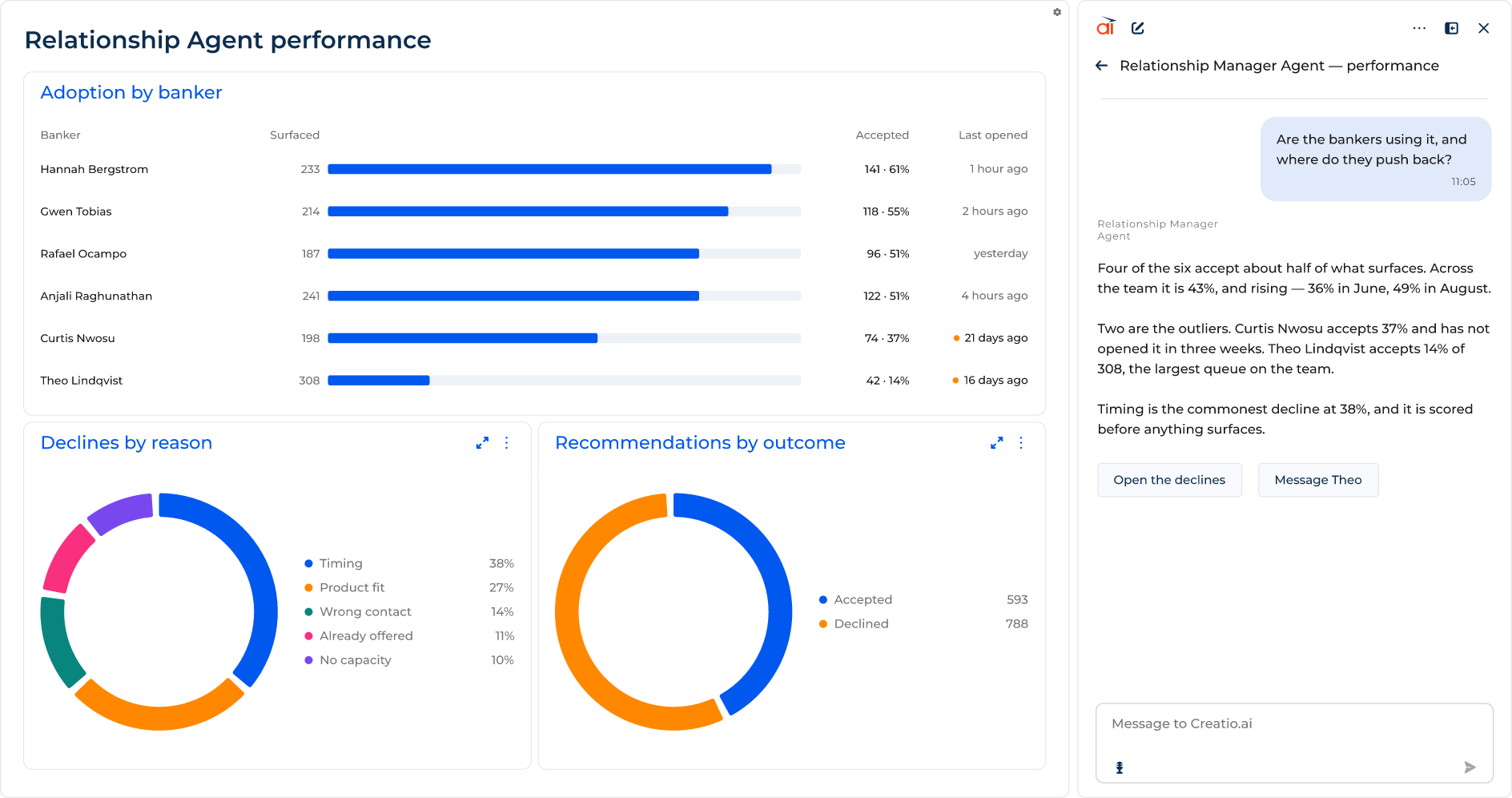
Relationship Manager Agent in Creatio Bank.AI
Custom AI Agents
Creatio AI Studio lets a financial institution build unlimited custom agents with no-code tools, using managed OpenAI, Google, and Anthropic models or its own model. Every agent, including external agents connected through MCP, runs under the same policies, approvals, human-in-the-loop rules, audit trail, and usage budgets.
Creatio Use Cases for Financial Services
The scenarios below show how Creatio works in practice, with the trigger, what the platform or agent does, and the result.
Digital customer onboarding and Know Your Customer (KYC). A prospect starts an account application on the web. The Customer Onboarding Agent guides the applicant, collects and verifies identity documents, runs KYC and AML checks against approved policy, prepares the file, and schedules the welcome conversation. A person reviews exceptions and approves the account.
Result: onboarding designed for 40% to 70% less manual effort, with every check stored for audit.
Loan and mortgage origination. A member applies for a loan in a branch or through a broker portal. The Product Application Intake Agent captures the application, gathers missing documents, runs eligibility checks, and prepares the loan file, citing the policy basis for each check. The loan officer reviews and decides.
Result: faster decisions on a complete file.
Commercial relationship management. A relationship manager has a quarterly review with a business client tomorrow. The Relationship Manager Agent assembles a relationship summary from the core, treasury, and lending systems, drafts a meeting brief with product gaps and risks, and proposes next steps in Outlook and Teams.
Result: less searching and typing, more time advising.
Deposit renewal. A certificate of deposit approaches maturity. The Renewal Agent identifies the maturing balance, scores the renewal and cross-sell options, drafts a personalized offer, and sends it through the member’s preferred channel; complex renewals route to the relationship manager.
Result: a Renewal Agent designed for renewal rates 5% or more higher.
Churn prevention. Transaction patterns show declining activity on a primary account. The Retention Agent flags the account, drafts outreach, and creates a task for the branch or contact center with full context.
Result: a timely, personal conversation; at Wings Credit Union, automated engagement journeys turned indirect auto loan members into lasting relationships.
Contact center. A member calls to dispute a card transaction. The agent desktop shows the member’s accounts, cards, and recent interactions; the Dispute Resolution Agent opens the case, collects the required details, checks the transaction against policy, and prepares the provisional credit for approval.
Result: routine disputes resolved in one contact.
Creatio Integrations with Core Banking and Fintech Systems
Creatio connects to a financial institution’s existing systems through open APIs (REST and OData), webhooks and events, pre-built Marketplace connectors, and the Model Context Protocol (MCP), which lets AI agents read live data and act across systems without copying data into the CRM. Creatio connects to the core and never replaces the system of record.
The integration categories Creatio supports for financial institutions are:
- Core banking systems
- Loan origination and processing, including indirect and digital lending
- Collateral, appraisal, and lien management
- Credit risk and underwriting
- Collections and delinquency management
- Identity, fraud, and risk verification
- Deposit account onboarding
- Payments and money movement
- Document management and imaging
- eSignature and digital consent
Named connectors available on the Creatio Marketplace or through Creatio partners include the Fiserv Premier connector (customer profiles, bank accounts, cards, and transactions imported into Creatio on demand, on a schedule, or in batch), the Jack Henry Symitar connector for credit unions (deposits, loans, and accounts), Sandbox Banking’s Glyue integration platform (connectors for 14 or more core banking platforms and more than 50 lending, deposit, KYC and AML, card, underwriting, and mobile banking solutions), several DocuSign connectors for e-signature, and native Microsoft 365, Outlook, and Teams integration.
Whether a sync is real-time and two-way depends on the connector and the core: event-driven integrations such as CEC Bank’s, where Creatio streams customer events to the core in real time, are two-way; the Fiserv Premier connector imports core data into Creatio on demand or on a daily schedule. IT typically owns the core integrations while business teams configure the workflows on top.
Creatio No-Code Customization for Financial Institutions
Creatio’s no-code tools let financial institutions start from pre-built financial services workflows and change them without developers. Freedom UI Designer builds interfaces by drag and drop, the process designer changes workflows and approval rules, and Creatio AI Studio configures agents, policies, and model choice.
Security, Compliance, and AI Governance for Financial Services
Creatio is certified to SOC 2 Type II and ISO 27001 and operates in compliance with GDPR, with encryption at rest and in transit, role-based access control, data masking, single sign-on, LDAP synchronization, and an unlimited audit and change log. The platform runs in Creatio’s cloud, in a private cloud, or on-premise, so institutions that must keep data and AI inference inside their own boundary can do so.
For industry requirements, Creatio provides KYC and AML workflows, stores every KYC and AML evaluation in the customer workspace for audit, and keeps a decision log for each agent action. Its interaction history, case records, and document management support recordkeeping obligations under GLBA and SEC and FINRA rules, and its reporting workflows generate regulatory reports from the same data.
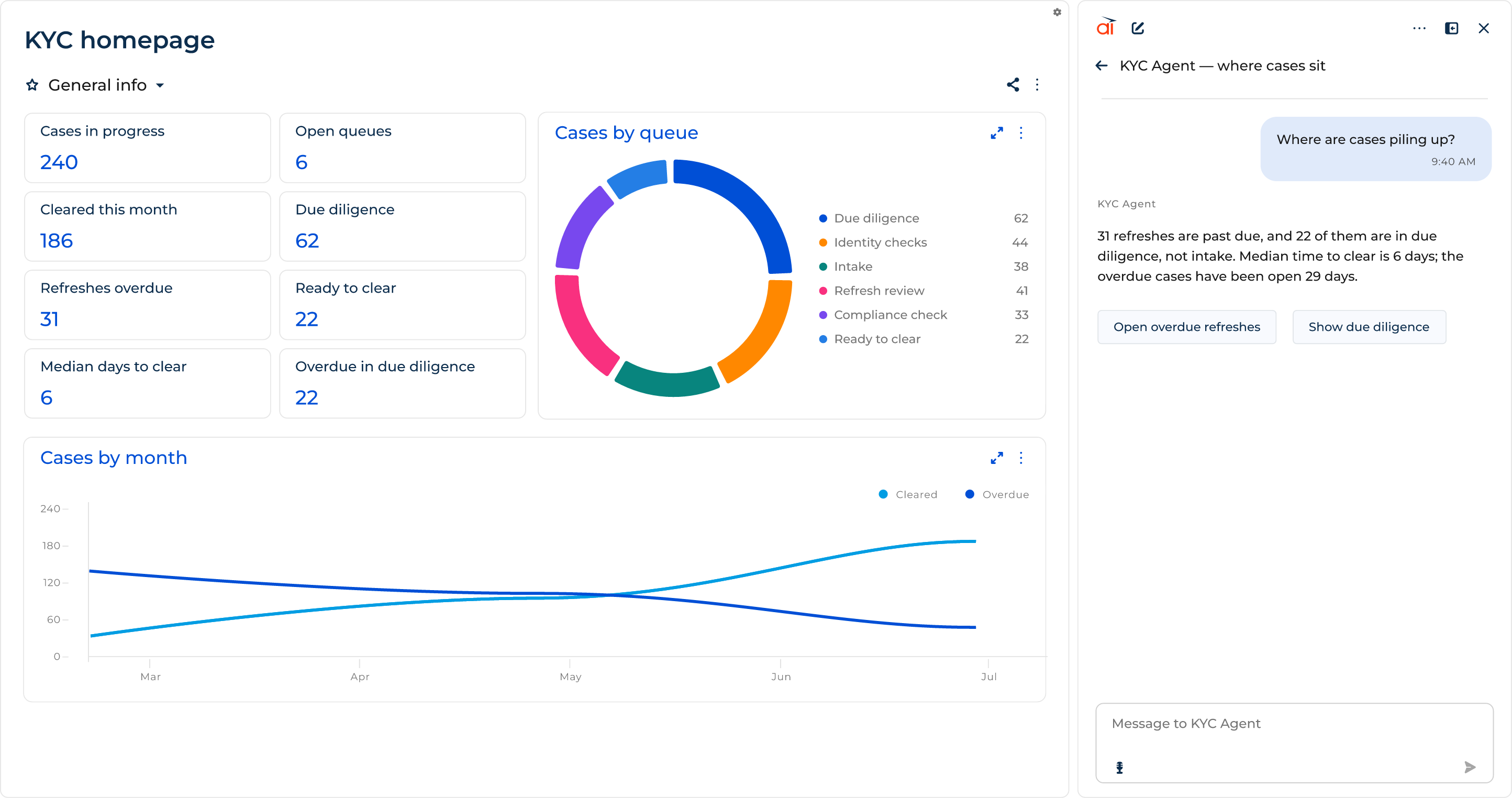
KYC workflow in Creatio Bank.AI
AI governance runs through Creatio AI Studio, one control plane for Creatio agents and external agents connected through MCP: policies, tool approvals, human-in-the-loop checkpoints, decision logs, observability, and usage budgets. Each tool call runs on its own or asks first, and any agent can be stopped or revoked centrally. Creatio never uses customer data to train AI models, and institutions choose which models run, including their own.
Financial Institutions Using Creatio
Financial services is Creatio’s largest industry, and the institutions below are examples of published Creatio customer stories across banking, credit unions, lending, and insurance.
Wings Credit Union (credit union, Colorado, 560,000 members, about $10 billion in assets). Challenge: siloed systems fragmented member data, and indirect auto loan members disengaged after funding. Solution: Member 360 across contact center, branches, and sales, automated onboarding journeys, and routing across 340 or more case types, live for 1,200 users in 3.5 months.
Outcome: 18.5% more new deposit conversions, 8.5% more new loan conversions, and about $1.4 million in annual revenue uplift.

We manage a group of 1,200 users with an admin team of just three people and we deliver the best CRM experiences we’ve ever had.
CEC Bank (retail bank, Romania, 1,000 or more branches, 2 million or more customers). Challenge: relationship managers and tellers worked across disconnected systems with inconsistent customer data. Solution: Romania’s first cloud CRM in banking, with Customer 360, leads and opportunities, case and complaint management, and marketing for more than 4,000 employees, with Creatio as the master data layer beside a modernized core.
Outcome: one customer-centric front office across the network.
Creatio CRM is a guide for CEC Bank: an intelligent assistant that accompanies us from prospecting all the way to putting a product on the balance sheet.
OTP Bank Romania (retail and commercial bank, 97 branches, 1,800 or more users). Challenge: slow response to customer needs and regulatory change. Solution: workflow automation for onboarding, data management, and lending.
Outcome: Creatio is the primary front office for customer-facing processes, with updates released every two weeks by the bank’s own teams.
Metro Bank (bank, United Kingdom). Challenge: an estate of more than 50 systems and a colleague interface the bank wanted to keep. Solution: Creatio supplies workflows and orchestration through APIs, with first proof in complaints and compliance.
Outcome: 1,500 or more users managed by a team of three.
First United Bank & Trust (community bank, United States, $1.9 billion in assets, 23 branches). Challenge: manual case handling and scattered customer data. Solution: case management, unified customer data, and workflow automation integrated with the core banking system.
Outcome: about 1,600 cases a month run by a three-person team.
Financial institution profiled by Nucleus Research (lender, about 1,200 employees, several billion dollars in assets). Challenge: seven disconnected legacy tools for onboarding, loan approval tracking, and document verification. Solution: consolidation into Creatio’s no-code environment, with IT owning core banking integrations and business users configuring workflows.
Outcome: 30% lower application management costs in the first year and new workflows delivered 60% to 70% faster.
Other financial institutions on Creatio include Consumers Credit Union, Heritage Life Insurance Company, Bank of Georgia, Raiffeisen Bank, BRD Groupe Société Générale, Ikano Bank, Lake City Bank, Union Bank & Trust, Avidia Bank, Banco G&T Continental, Bay Federal Credit Union, Everwise Credit Union, Saskatchewan Blue Cross, MetLife Colombia, and Scottish Friendly.
Business Outcomes with Creatio for Financial Services
Financial institutions report measurable results with Creatio at three levels: the platform, individual customer deployments, and AI agents.
Platform. Nucleus Research measured 37% lower technology cost, implementations 70% faster than the comparison set, and 61% faster lead response for Creatio customers. Gartner names Creatio the only Visionary in the 2026 Magic Quadrant for CRM Sales Platforms, Forrester rates Creatio a Strong Performer in The Forrester Wave: CRM Software for Financial Services, Q1 2025, and Omdia names Creatio a Leader in its 2026 Universe for Customer Engagement Platforms. Customers rate Creatio 4.8 out of 5 on Gartner Peer Insights and 4.6 out of 5 on G2.
Customer results. Wings Credit Union increased new deposit conversions 18.5%, new loan conversions 8.5%, and annual revenue by about $1.4 million. A lender profiled by Nucleus Research cut application management costs 30% and delivered new workflows 60% to 70% faster. Consumers Credit Union replaced 15 systems with one. Metro Bank and Wings Credit Union each run Creatio for 1,200 to 1,500 or more users with administration teams of three.
AI agents (Creatio Bank.AI). Bank.AI use case documentation sets designed outcomes for its pre-built agents: 30% or more additional referrals from the Referral Agent, two to four times faster onboarding and 40% to 70% less manual onboarding effort from the Customer Onboarding Agent, and renewal rates 5% or more higher from the Renewal Agent. These are designed outcomes confirmed against agreed baselines in each deployment, not averages across customers.
Creatio CRM for Financial Services Pricing & Licensing
Creatio prices its financial services CRM in two ways: the Unlimited Enterprise model, which is Creatio’s default for midsize and large institutions, and per-seat Growth and Enterprise plans.
Unlimited Enterprise. One annual platform subscription, sized to the institution, includes unlimited users, applications, workflows, records, and API access; the Creatio Financial Services CRM product along with Sales, Service, and Marketing; dedicated cloud resources or on-premise deployment; single sign-on, LDAP, and unlimited audit logging; SOC 2 Type II and HIPAA compliance; premium support with a dedicated customer success manager; and 10,000 bundled AI credits. There is no per-agent, per-seat, or per-resolution fee to access AI agents. The only additional cost is for AI usage, metered with flexible AI Credit packages and choose-your-own model cost controls (see below).
Per-seat plans. Growth and Enterprise plans are priced per user per month, starting at $55 and $70 respectively, and each CRM product (Sales, Marketing, Service, or Financial Services) adds $15 per user per month. Growth is cloud only; Enterprise and Unlimited run in the cloud or on-premise.
AI packages. Creatio AI is metered in AI Credits, one universal unit for any model, modality, or provider. Packages are Start ($5,000), Grow ($25,000), Accelerate ($75,000), Scale ($150,000) and Freedom (custom, with bring-your-own-model and on-premise AI). Unused credits roll over and additional blocks of credits can be purchased at the current package price without upgrading to a different package tier.
Total cost of ownership. Because one subscription covers the platform, the financial services CRM product, and every user and workflow, extending Creatio from one department to the whole institution does not add seat or module cost. Nucleus Research measured 37% lower technology cost for Creatio customers.
Current list prices are on the Creatio pricing page.
Summary
Creatio CRM for financial services is an AI CRM and workflow platform where bankers, advisors, service staff, and AI agents work together on one customer record, beside the core banking system, with no limits on users, agents, workflows, or scale. Delivered as Creatio Bank.AI for banks and credit unions and as industry workflows for lending, wealth, and insurance, it combines pre-built workflows, governed AI agents, and no-code customization that business teams own. Institutions such as Wings Credit Union, CEC Bank, and Metro Bank run it at scale with administration teams of three. Request a demo to see Creatio for financial services.
FAQ
Who are the main competitors of Creatio CRM for financial services?
Creatio’s main competitors in financial services are the enterprise CRM suites with financial services editions, Salesforce Financial Services Cloud and Microsoft Dynamics 365, and segment specialists: BUSINESSNEXT in banking and credit unions, Total Expert and ICE Surefire in mortgage, Applied Epic and AgencyBloc in insurance agencies, and Wealthbox and Redtail in wealth management. Creatio differs from the suites in licensing (one Unlimited subscription rather than per-user editions plus AI add-ons) and from the specialists in breadth: one platform covers growth, service, and operations across banking, lending, wealth, and insurance, with AI agents and no-code customization built in.
How does Creatio compare to Salesforce Financial Services Cloud?
Both offer a financial services data model, customer 360, and AI agents. The differences are architecture, who makes changes, and price. Creatio runs CRM, workflows, and agents on one platform and data model with no-code tools that business teams use; Salesforce assembles separately licensed clouds, an industry edition, Agentforce, and Data 360, with changes typically made by certified administrators and developers. Salesforce lists Core, Advanced, and Max editions at $195, $395, and $550 per user per month (September 2026), with Agentforce for employees bundled only in Max and otherwise $150 per user per month on Financial Services Cloud; Creatio’s Unlimited Enterprise is one platform subscription with no per-user or per-agent access fees, and Nucleus Research measured 37% lower technology cost for Creatio customers.
How does Creatio compare to Microsoft Dynamics 365 for financial services?
Microsoft Dynamics 365 delivers financial services capability through separately licensed applications (Sales, Customer Service, Customer Insights) plus industry accelerators, partner solutions, and Copilot Studio, each priced per user or per capacity. Creatio delivers banking, lending, wealth, and insurance workflows and pre-built agents on one platform under one Unlimited subscription, and integrates natively with Microsoft 365, Outlook, and Teams, so institutions keep their Microsoft productivity tools. Creatio’s financial services workflows and agents are part of the platform rather than assembled from applications, accelerators, and partner add-ons.
Can Creatio integrate with our core banking system?
Yes. Creatio connects to core banking systems through open APIs, events and webhooks, Marketplace connectors, and MCP, and does not need to replace the core as the system of record. Pre-built connectors exist for Fiserv Premier and Jack Henry Symitar, Sandbox Banking’s Glyue platform adds connectors for 14 or more cores, and customers such as CEC Bank, First United Bank & Trust, and Consumers Credit Union run Creatio integrated with their cores and loan origination systems.
How long does it take to implement Creatio at a bank?
Creatio implementations at banks and credit unions typically run in months, not years: Wings Credit Union went live for 1,200 users in 3.5 months, a lender profiled by Nucleus Research completed its initial phased deployment in six months including training, and Nucleus measured Creatio implementations 70% faster than the comparison set. Timelines depend on the integrations and workflows in the first release; most institutions start with one domain, such as service or onboarding, and expand with their own no-code teams.